Our bills are high.
One mayoral candidate is to blame: Kenyan McDuffie.
DC residents are paying utility bills that are higher than ever before, all while utilities are making more in profit than at any time in the last four years.
Before resigning from the DC Council, Kenyan McDuffie chaired the committee charged with overseeing the DC Public Service Commission (PSC), the agency that approves utility rates — McDuffie was responsible for oversight.
While he had this responsibility, there were demonstrable problems at the PSC — even members of the PSC itself were raising the alarm about for-profit utilities raising rates unjustly. McDuffie did next to nothing. Rate hike after rate hike was passed on to DC residents. All the while, McDuffie had close relationships with for-profit utilities: McDuffie took thousands in campaign donations, and his office was a revolving door as his top advisors were hired as corporate utility lobbyists.
McDuffie has a long record of acting in the best interests of for-profit utilities, not DC residents.
Make sure you consider all of the facts this election season. We cannot afford McDuffie as mayor. Literally.
Click on the links below to learn more about Kenyan McDuffie’s inaction, lack of oversight, coziness with for-profit utilities, and all he has done to put special interests ahead of the public interest.
Utility costs have skyrocketed under McDuffie’s watch. Rising costs are uniquely bad in DC.
Since 2017, one person has had oversight over this system: Kenyan McDuffie.
McDuffie consistently defended the interests of utilities, not the needs of DC residents.
McDuffie’s relationship with corporate interests is part of a pattern.
Utility costs have skyrocketed under McDuffie’s watch.
Over the past few months, many of us are paying the highest utility bills of our lives.
While utility prices are up across the country, DC’s bills are worse. In the past decade, DC residents have seen their bills rise far faster than our neighbors in MD and VA. The comparison to VA is particularly remarkable: nearby Loudon County has been called the “data center capital of the world”.
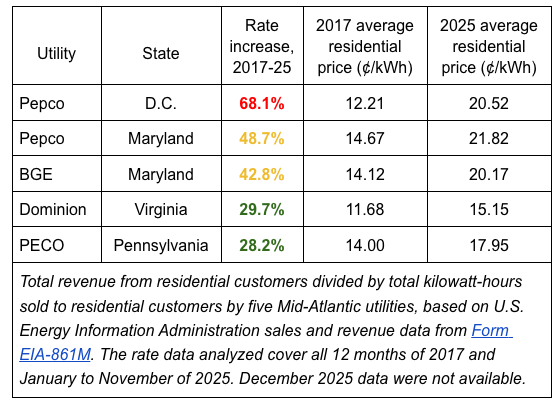
In fact, DC saw the largest electricity cost increase of any jurisdiction in the nation — 93% from 2020 to 2025 — outpacing even California, where ratepayers are footing the bill for billions in wildfire mitigation.
Utility profits are skyrocketing. Last year, Pepco made over $401 million in pure profit, the highest profits the company has achieved in the past 4 years.
DC residents are suffering. Utility shutoff rates have shot up as more and more residents fall into utility debt due to unaffordable energy bills.
DC residents are paying some of the highest bills of their lives right now, even as DC’s for-profit utilities are raking in historic profits.
All under McDuffie’s watch.
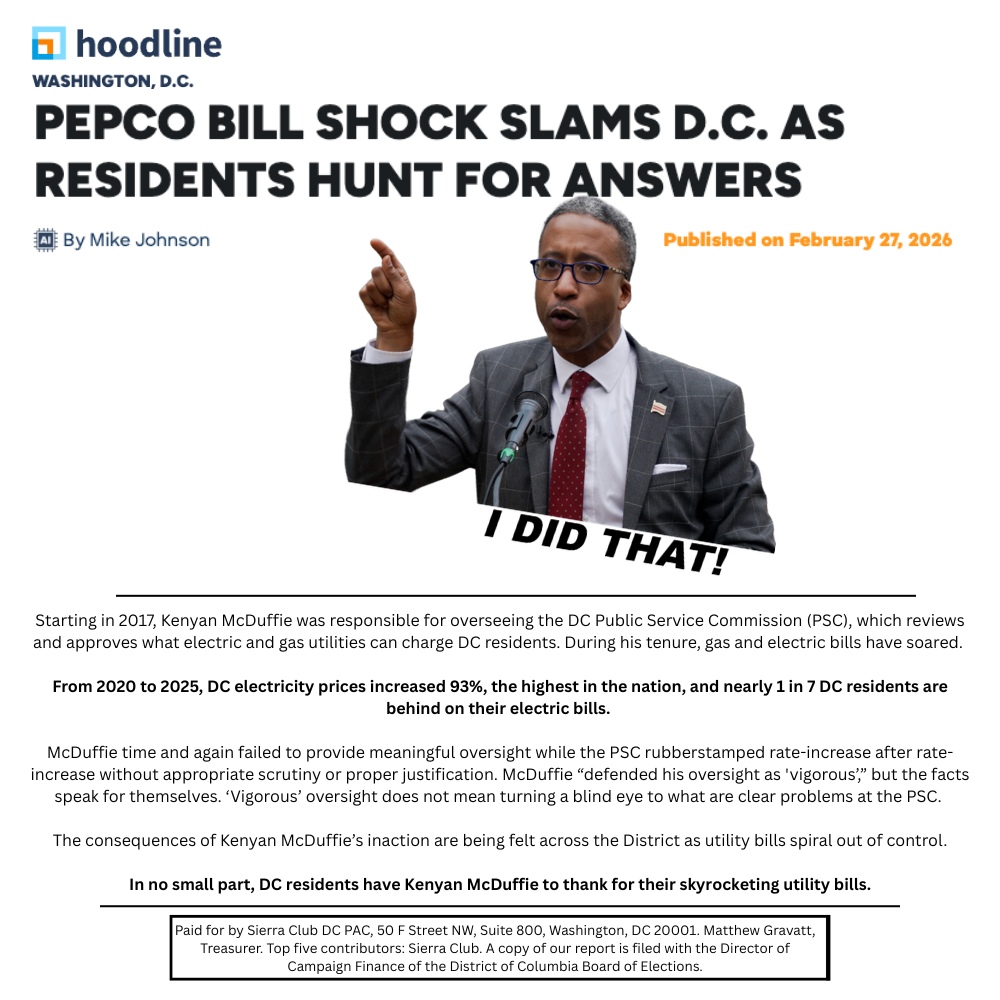
For most of the past decade, former Councilmember Kenyan McDuffie served as the chair of the Committee of Business and Economic Development. Under McDuffie, this committee had the responsibility to oversee DC’s utility regulator: the Public Service Commission (PSC).
McDuffie says he provided “vigorous” oversight during this time, but the record shows the PSC consistently prioritized for-profit utilities over DC residents during McDuffie’s tenure. If McDuffie indeed was "vigorously" reviewing the actions of DC’s regulators and utilities, that means he reviewed and approved of all of the following:
Through a number of contentious decisions, the PSC approved several gas and electric rate increases that raised energy costs for DC residents. Three commissioners sit on the PSC, and together they vote on whether a proposed rate increase is “reasonable, just, and nondiscriminatory”.
On electricity rates alone, rates were increased in 5 of the last 6 years due to a series of 2-1 votes at the commission. The dissenting vote (Commissioner Beverly) has been increasingly alarmed in each of his written dissents, claiming that the commission was approving these rate increases without the proper scrutiny.
In a dissent in late 2024, Beverly made one of his most forceful arguments yet:
“I can’t see the process in this case as anything other than a regulatory trainwreck that unreasonably promotes Pepco’s interest at the expense of ratepayers.”
“Unfortunately, the only thing that is clear to me about this arrangement is that ratepayers (including the Federal and District governments) are being given a bill for one hundred and twenty-three million dollars with a justification that, to me, could be summarized as ‘because Pepco said so.’ I cannot, in good conscience, find that this arrangement is in the public interest so I must respectfully dissent.” Source - FC1176, pg 5 of Dissent.
The PSC’s lack of thorough review was so alarming that they were taken to court -- a rare and serious action.
In 2024, the Office of the People's Counsel (OPC) and an association of building owners took one of the PSC’s rate hikes to an appeals court, saying that the commission had not done proper due diligence on the facts before approving the rate hike. Just earlier this year, the appeals court agreed and remanded the rate hike, sending it back to the PSC to properly reconsider.
This was a big deal. Typically, the courts side with regulators, giving them deference on how to regulate utilities. The fact that the court reviewed the case and agreed that the PSC simply did not do an adequate job is rare and incredibly damning.
“Vigorous” oversight would have reasonably responded to all of this, resulting in tough questions for the PSC. Commissioner Beverly’s blistering and public dissent should have set off alarm bells for any reasonable overseer, especially a ‘vigorous’ one as McDuffie claims to be. McDuffie did next to nothing.
As Councilmember Robert White said during a recent council event: “Pepco is fighting for Pepco. The PSC is fighting for Pepco, so who the hell is fighting for the people?” (Source: District Line Daily Newsletter 3/31/2026, Washington City Paper)
Since 2017, one person has had oversight over this system: Kenyan McDuffie.
In short, for years, there have been clear warning signs that the PSC has not been acting in the best interests of DC residents.
PSC leadership has been clearly and publicly divided, with one commissioner consistently raising the alarm as costs have risen amid inadequate oversight. Things were so bad that the commission was taken to court, and lost.
All under McDuffie’s watch.
McDuffie didn’t write a single bill or hold a single roundtable trying to fix problems at the PSC or address rising bills. He voted against PSC reform.
McDuffie was chair of the Committee on Business and Economic Development from 2017-2025. This committee had direct oversight over the Public Service Commission, and committee chairs have the responsibility to pay close attention to agencies under their purview.
Beyond his required duty to hold yearly oversight hearings over the PSC, McDuffie had nearly a decade to take action in other ways: 1) to draft legislation addressing problems at the PSC, or 2) to hold additional roundtable reviews of the commission to dig into key questions or concerns.
On the question of roundtables: from 2017-2025, outside of annual oversight hearings required by law, McDuffie did not hold a single additional oversight hearing or roundtable on Pepco, Washington Gas, the Public Service Commission, utilities, electricity, or gas.* If there were clear public problems at the PSC, and the councilmember was indeed conducting “vigorous” oversight, we would expect scrutiny in the form of additional formal proceedings.
As far as legislative efforts, one attempt at PSC reform came in 2021 from Councilmember Mary Cheh. She introduced a bill that would require at least one member of the Public Service Commission “shall have experience in electric grid modernization and renewable energy integration or technology and, where possible, issues impacting the environment.” This was not required of commissioners previously. Having commissioners with a strong background in these issues is a common-sense reform that you would expect would lead to stronger decisions and outcomes.
McDuffie was one of only two councilmembers to vote against this PSC reform bill.
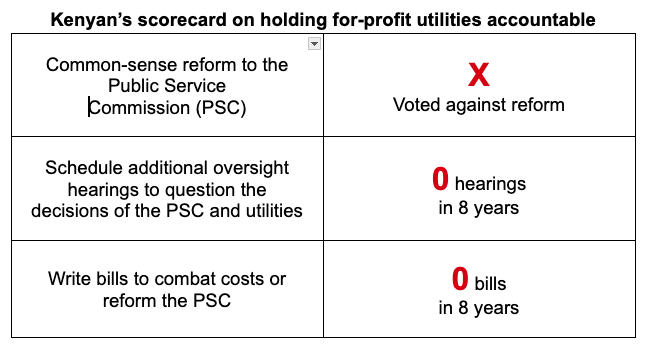
From 2017-2025, while the PSC was approving cost increases year after year, the following* are all of the utilities or energy-related bills that McDuffie was the primary author of. Neither addresses structural issues at the PSC, or lower costs for DC residents.
Nonprofit Solar Tax Exemption Act (introduced in 2024, then reintroduced in 2025) - exempts buildings and land used for solar from property taxes (bill has not passed).
Electrical Utility Underground Work Wage Act of 2024 - establishes a prevailing wage for utility workers and gives the DC government power to enforce those wages (read more on this bill later. While this eventually passed after four years of delay, McDuffie failed to fund it, leaving it unenforceable).
Electric Company Infrastructure Improvement Financing Emergency Declaration Resolution of 2017 - this allowed DC and Pepco to collect additional charges to finance the undergrounding of electric power lines and other infrastructure.
Nearly a decade of leadership over the utilities sector, and yet McDuffie did not draft a single piece of legislation to address the problems at the PSC, or utility bill costs for DC residents.
McDuffie has claimed recently that he “led the effort to ban utility shut offs” during the pandemic. It is not clear which legislative effort he is referring to. This bill created a moratorium on utility shut offs in 2021, but it was introduced by Council Chair Phil Mendelson. The bill passed unanimously; every councilmember voted in favor.
McDuffie did co-introduce two bills related to utility and energy topics*, but co-introduction is not the same as being the primary author of a bill. Councilmembers often add co-introducers to their bills to build support for the legislation. Co-introducers rarely if ever are the lead author of the legislation, and bills often have many co-introducers.
Even at this less-involved level of policy leadership, McDuffie’s record from 2017-2025 is sparse:
Renewable Energy Future Amendment Act (2019, primary author: Robert White. McDuffie was one of 13 cosponsors - the entirety of DC Council) - the bill mandated a review of the potential for solar and wind energy at every District-owned building.
Automatic Enrollment for Utility Affordability Programs Act of 2025 (2025, primary author: Charles Allen. McDuffie and Janeese Lewis George co-introduced as two of six total cosponsors) - the bill creates a policy to automatically enroll low-income residents into utility assistance programs. This bill has not passed yet and is going through the legislative process. McDuffie is no longer on the DC Council and will not have the chance to vote on this bill.
*Search terms entered in LIMS: electricity, energy, gas, utilities, pepco, washington gas, public service commission; Council periods 22-26.
McDuffie had the power -- and responsibility -- to question the PSC’s rulemakings and decisions, especially when they were not in the public interest.
He chose to ignore alarm bells from within the PSC’s leadership itself and not to engage in meaningful oversight. In addition, he did not draft a single piece of legislation addressing rising costs or reforms at the PSC, even when there were visible and highly public problems at the commission.
The question is:
Why did McDuffie choose to look the other way?
McDuffie is too close to for-profit utilities.
Multiple top staff members have left McDuffie’s office to lobby on behalf of the utilities.
Three of McDuffie’s former chiefs of staff went on to work as lobbyists on behalf of Pepco and Washington Gas: Corey Anez Griffin, Ronan Gulstone, and Laisha Dougherty.
McDuffie’s former campaign treasurer, Eric Grant, works as a senior manager at Pepco.
Utility executives have consistently rallied behind McDuffie. McDuffie has accepted more than twice as much in campaign donations from utility interests than any of his current council peers. Since 2014, only former mayor Vince Gray took in more contributions from utility employees than McDuffie for council elections.
Public records show that since 2014, McDuffie’s campaign donors include utility CEOs, lobbyists, vice presidents, lawyers, and many others with close ties to Pepco and Washington Gas. Clearly, the for-profit utilities had a preferred candidate in McDuffie, and in 2026 they have a clear favorite candidate for mayor.
From 2018-2025, McDuffie met with paid lobbyists retained by for-profit utilities five times more often than any other councilmember. Communications between DC Councilmembers and lobbyists are supposed to be strictly regulated, and filings during these seven years shows that McDuffie had dozens of reported meetings with those paid to represent utilities.
All of this paints a troubling picture: a revolving door between McDuffie’s team and for-profit utilities, thousands of dollars in campaign donations from utility interests, and five times as many meetings with utility lobbyists compared to any other councilmember. All while utilities raked in billions of dollars in profits from our skyrocketing bills, and pushed the PSC to increase costs on DC residents year after year.
The facts are unavoidable.
It’s clear who the utilities want to be DC’s next mayor: Kenyan McDuffie.
McDuffie consistently defended the interests of utilities, not the needs of DC residents.
It’s one thing to ignore your duty to provide oversight when utility bills are rising, and an internally divided PSC keeps approving rate hikes. It’s another thing entirely to take legislative action that benefits for-profit utilities.
McDuffie has consistently fought for the interests of utilities during his tenure on the DC Council. The following examples illustrate his approach, often working behind the scenes and at the last minute on changes that benefit for-profit utilities.
2015: McDuffie voted in support of a last-minute budget amendment that killed a study to evaluate the feasibility and savings of a local municipal power utility. Instead, study funding was diverted to programs more favorable to Pepco.
2018: McDuffie introduced an “11th-hour dump” of amendments, seemingly at Pepco’s request, that would have allowed Pepco to double-charge DC residents for the same energy efficiency measures.
2018: McDuffie stripped out a provision from a bill that would have required Pepco to purchase renewable energy through long-term contracts, an approach that was expected to deliver substantial savings to DC customers based on their use in other jurisdictions. This ultimately left DC residents exposed in the coming years to increased volatility in regional energy markets caused by things like data centers.

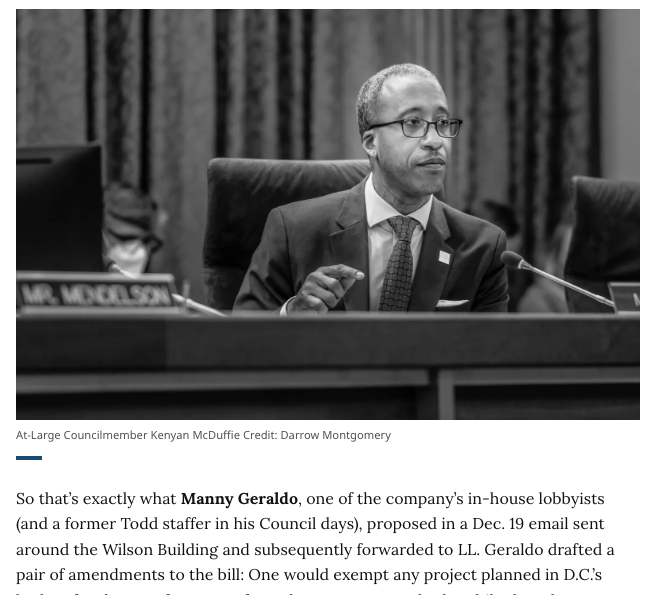
Excerpts from Washington City Paper, January 2023
2023: McDuffie pushed last-minute amendments to a landmark clean energy law that were initially proposed by Washington Gas. The councilmember in charge of the environmental committee at the time told McDuffie on a phone call that “he could choose bonafides to the company if he wanted to do that,” but that these amendments were “a futile act” and completely against the climate benefits of the bill: “There’s no point [in the amendments] if we’re serious about this.”
2021-2025: In 2021, McDuffie promised a bill to DC’s underground gas and electric utility workers to uplift and protect their wages. After multiple years of delay and opposition from the for-profit utility companies, the bill expired in McDuffie’s committee and had to be reintroduced. It took five more years to get the bill passed, but then in 2025, McDuffie neglected to fund it (a cost of just a few hundred thousand dollars) before he resigned to run for Mayor. McDuffie dropped the ball, and today, DC underground utility workers continue to face lower wages and lack wage guarantees.
McDuffie has consistently stood up for the interests of for-profit utilities, not for the interests of DC residents .
McDuffie’s actions, often in close partnership with DC’s for-profit utilities or even at their request, have exposed DC residents to higher costs and less protection from skyrocketing bills.
McDuffie’s relationship with corporate interests is part of a pattern
McDuffie doesn’t only put utilities first, he puts the interests of insiders and his friends ahead of the people of DC. There is an unfortunate pattern across McDuffie’s career involving some high-profile cases:
McDuffie pushed an eight-billion-dollar Medicaid contract to his former staffer’s company, which had a history of price gouging.
McDuffie changed his position to support a no-bid gambling contract that listed his cousin, raising concerns among the Council and forcing him to defend his actions.
McDuffie voted against an amendment that increased oversight of government contracts. The legislation lowered the threshold for additional oversight from $500,000 to $250,000.
What does it all mean?
Our bills are higher than ever before, while utilities are making more in profit than at any time in the last four years.
There were demonstrable problems at the PSC for years. McDuffie did next to nothing, and rate hike after rate hike was passed on to DC residents.
Records show McDuffie’s close relationships with for-profit utilities: he took thousands in campaign donations, and his office was a revolving door as his top advisors were hired as corporate utility lobbyists.
McDuffie has a long record of acting in the best interests of utilities, not DC residents.